
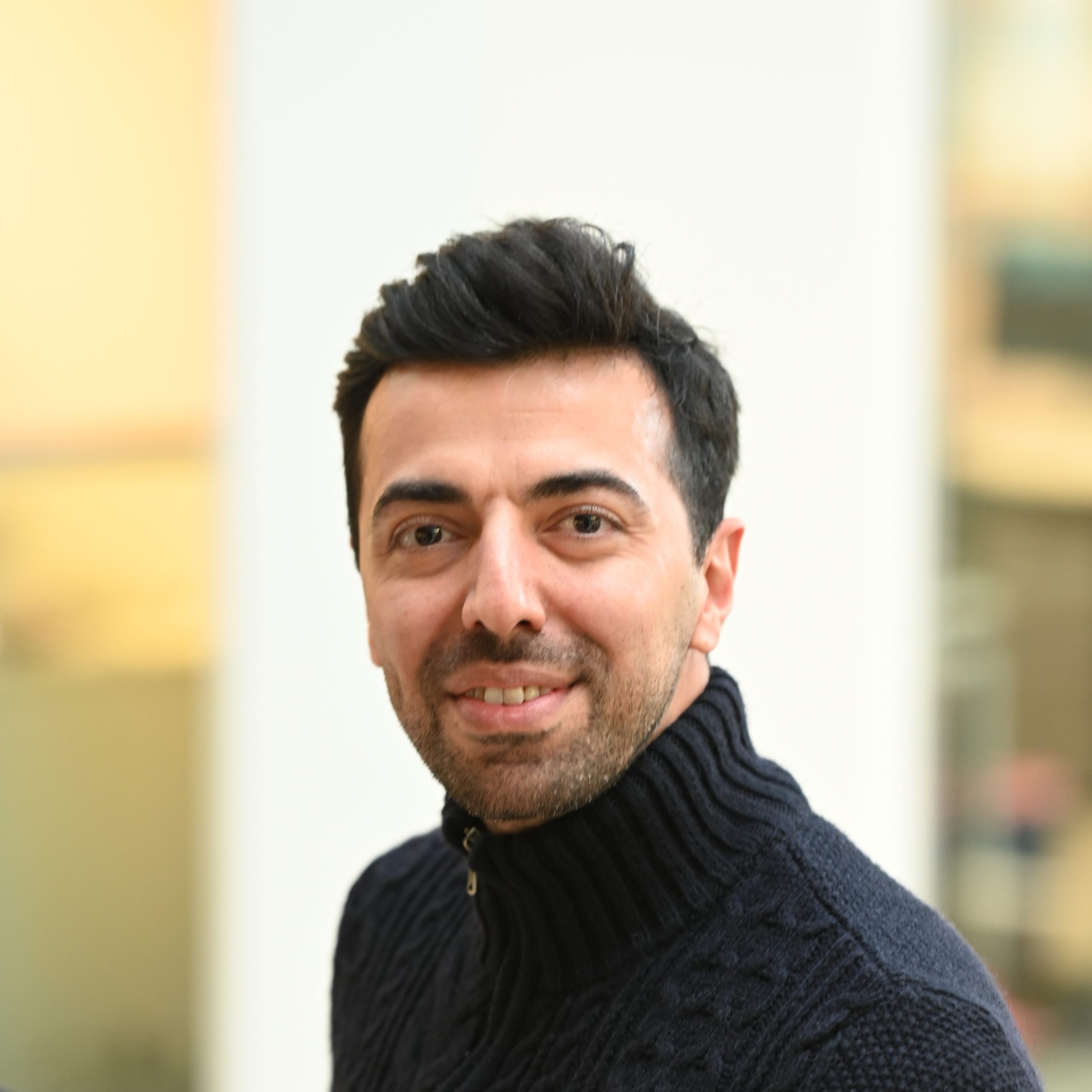
Farhad Shamsfakhr
Senior Robotics Research Engineer
Farhad develops autonomous robotic systems for real-world operation under uncertainty and resource constraints. He builds modular software stacks that combines heterogeneous sensor perception (RF, LiDAR, and vision) and state estimation with robust control, backed by real-time safety and system health monitoring—validated from simulation and HIL to on-robot trials.
Tell us about your journey before you joined the Centre for AI in Assistive Autonomy?
I earned a PhD in Mechatronics and Systems Engineering at the University of Trento, focusing on uncertainty-aware localisation and navigation. I also conducted visiting research at the University of Klagenfurt (CNS) and Mitsubishi Electric Research Laboratories (MERL), working on multi-sensor SLAM and pose-graph optimisation. I later joined Fondazione Bruno Kessler (FBK), where I held senior roles delivering robust autonomy for resource-limited platforms, taking systems from simulation through field validation across several major European initiatives.
What motivates you to work in this area?
I’m motivated by building autonomous systems that work reliably in the real world—when conditions are uncertain and information is incomplete. I enjoy being the person who closes the loop, taking an idea all the way from concept to a working solution and turning algorithms into practical, tested implementations that deliver real impact.
What do you love about Edinburgh?
I love how Edinburgh feels made for wandering—historic streets, sudden viewpoints, and nature right on the doorstep. When I’m not tinkering, I’m usually out with a camera, trying to capture a little of that atmosphere.