
NEWS
Human-Centred Autonomy Takes Centre Stage at Inaugural Gathering
Edinburgh, UK – 24th November 2025
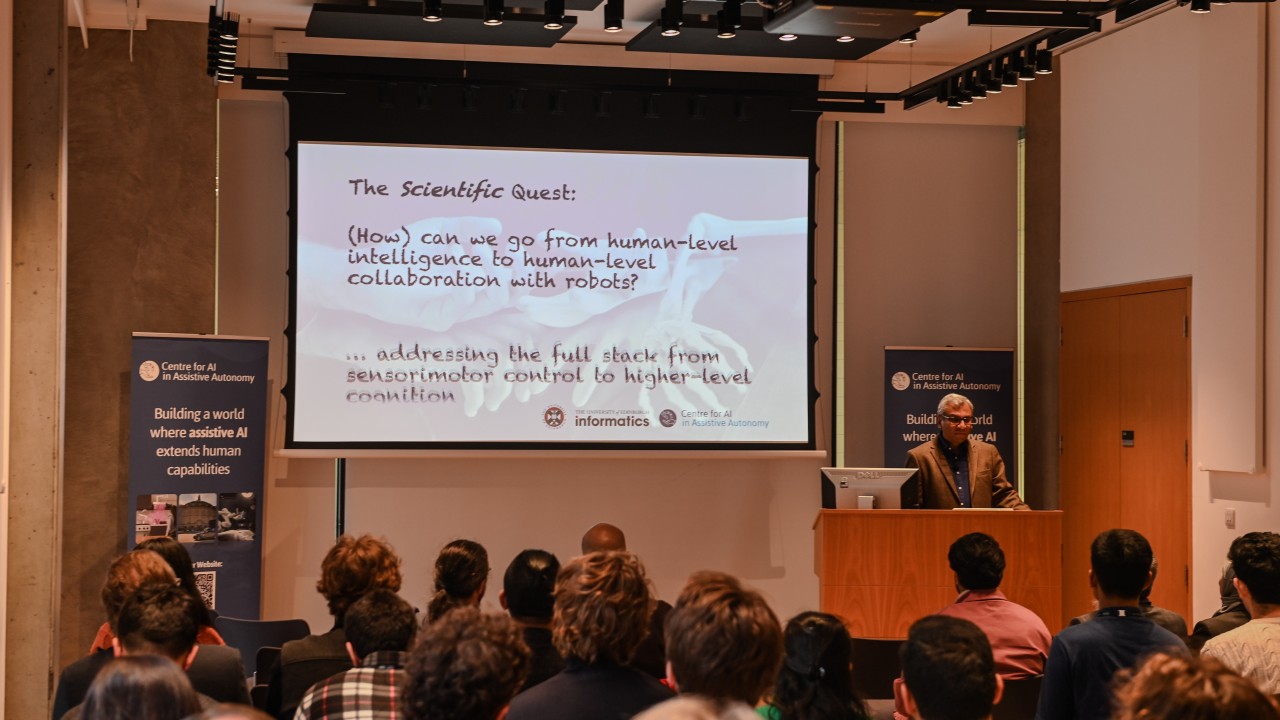
Photo: Professor Subramanian Ramamoorthy delivering the opening keynote
The University of Edinburgh marked a major milestone in the evolution of human-centred artificial intelligence with the inaugural event of the Centre for AI in Assistive Autonomy. Hosted at the School of Informatics—the UK’s largest and one of Europe’s leading institutions for AI—the event brought together researchers, industry partners, and thought leaders to explore how AI can extend human capabilities in mobility, healthcare, and beyond.
Setting the Vision
The day opened with a welcome from Professor Iain Gordon Vice-Principal and Head of the College of Science and Engineering, who celebrated Edinburgh’s proud legacy as a global leader in AI and interdisciplinary research. He highlighted the pivotal role of the UKRI Turing AI World-Leading Researcher Fellowship, awarded to Professor Subramanian Ramamoorthy in 2024, in establishing the Centre and enabling its ambitious vision.
In his keynote, Professor Subramanian Ramamoorthy, Director of the Centre, shared a compelling vision: a world where assistive AI extends human capabilities. He outlined the Centre’s mission to advance interactive AI and enable transformative technologies for mobility and healthcare. Framing the challenge as moving beyond human-level intelligence toward human-level collaboration, he emphasised the need to address the full stack—from sensorimotor control to higher-level cognition—across three mission areas: Assistive Care, Assistive Driving, and Assistive Surgery.
Professor Subramanian Ramamoorthy outlined a translational approach — “from bench to bedside”—developing the science of assistance and applying it to real-world practice. Each mission spans the journey from creating new datasets to engineering deployable systems, with data, software, and system assets forming the foundation for collaboration. His keynote concluded with a call for partnerships, inviting researchers, industry, and healthcare stakeholders to co-create technologies that are safe, adaptive, and truly human-centred.
Exploring the Science Behind Assistive AI
Morning sessions showcased the depth and diversity of the Centre’s research. Dr Bonan Zhao (University of Edinburgh) offered insights into making machines “more human,” explaining how computational models of thought can inform adaptive AI systems. Professor Thusha Rajendran (Heriot-Watt University) followed with a discussion on trust in human-robot interaction—a critical factor in designing socially assistive technologies for individuals with developmental conditions.
From Driving and Dementia to Surgical Assistance
After a networking break, the focus shifted to real-world applications. Professor Gustav Markkula (University of Leeds) demonstrated how shared autonomy can help older adults maintain independence behind the wheel while improving safety for all drivers. In the afternoon, Professor Arlene Astell (University of Toronto) delivered a powerful talk on assistive care and aging well, emphasising co-design and partnership with end-users.
The final sessions explored autonomy in surgical contexts. Ms. Shafaque Shaikh (NHS Grampian) presented on robotic and technology-enhanced surgery, highlighting adaptive assistance and the need for richer surgical datasets. Dr. Connor Boyle (University of Edinburgh) introduced surgical sabermetrics—a data-driven approach to quantifying skill and optimising outcomes.
Throughout the day, the Centre’s post-doctoral researchers showcased innovative cross-cutting methods: Manisha Dubey on generative modelling and cognition-aware interaction, Matías Mattamala on Assistive Care, Emanuele De Pellegrin on Assistive Driving, and Yuhui Wan on Assistive Surgery—underscoring the Centre’s commitment to human-centred, adaptive AI.
Why This Matters
The Centre’s launch signals a new era for assistive technology—one where AI is not just intelligent, but empathetic, adaptive, and aligned with human needs. By integrating robotics, cognitive science, and healthcare expertise, the Centre aims to tackle pressing societal challenges: supporting independent living, enabling safe mobility, and enhancing surgical precision.
“We believe autonomy must be human-centred—grounded in predictive models of individual capability, shaped by adaptive interaction, and guided by shared reasoning. This is how we achieve true collaboration between humans and machines.” – Professor Ramamoorthy